Employee Engagement Survey Template
Used 339,000+ times
Get the feedback you need to measure, track, and improve employee engagement.
Why this employee engagement questionnaire works
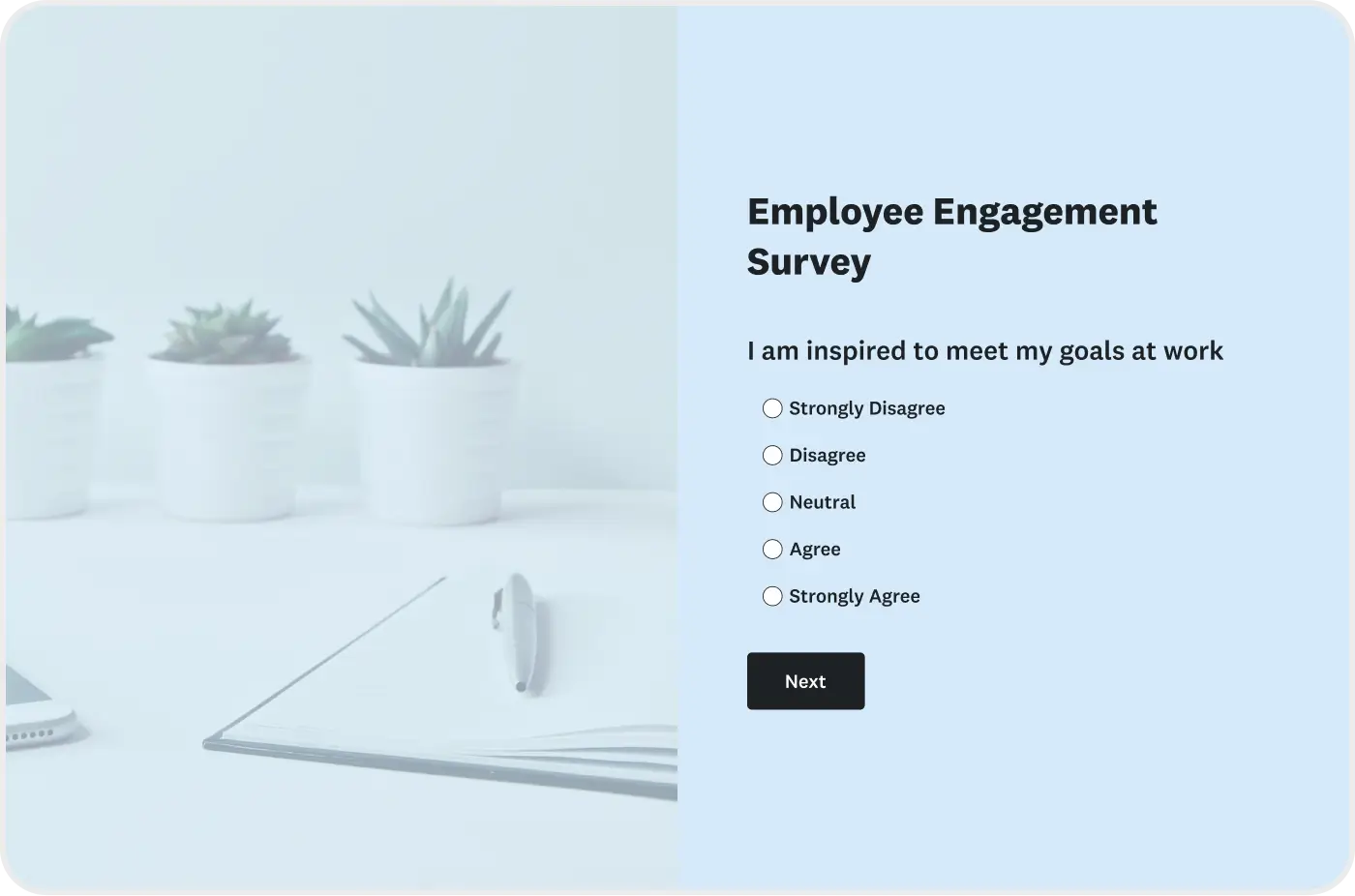
This Employee Engagement Survey Template is designed for action. It efficiently captures workplace sentiment using expert-written questions across core themes: motivation, leadership, growth, recognition, and culture.
You get a straightforward path from raw responses to practical insights. The template is fully customizable to match your organization's language and programs, and its built-in analysis tools easily segment responses and spot key patterns.
For added context, you can compare your scores against SurveyMonkey Employee Engagement Benchmarks, turning your results into clear priorities that keep employees happy and engaged.
Understand what drives employee satisfaction and retention
Our Employee Engagement Survey Template is meticulously designed to deliver accurate, actionable data by balancing smart design with stringent anonymity protocols.
Our employee engagement survey questions use a standardized 5-point Likert scale. This consistent scale provides dual benefits for data quality:
- Captures nuance: Provides enough range for employees to accurately express the strength of their feelings without causing survey fatigue.
- Simplifies analysis: Makes it easier to reliably compare scores across different teams, locations, and over time.
To encourage candid, open feedback, our survey platform allows you to implement industry-leading anonymity practices:
- Enable anonymity first: Always activate the Anonymous Responses feature in the 'Collect Responses' section before distributing the survey, especially when surveying small groups.
- Protect identities: Strictly avoid asking for names, email addresses, or any other demographic details that could uniquely single out an individual employee.
- Use minimum group size for segmentation: When you segment results (e.g., by department or tenure), enforce a minimum group size (such as 5–10 responses per slice). This crucial step ensures you maintain useful data segments while rigorously protecting individual identities from being exposed.
Example employee survey questions that start meaningful conversations
These employee engagement survey example questions show the common themes covered in this template. Each group has a different focus, and the items build a clearer picture of what shapes engagement and retention. Use them as a reference when reviewing the template, or add your own questions to maintain a good mix of themes.
Role and job satisfaction
- How clear are the responsibilities in your current role?
- I am satisfied with the variety and complexity of my tasks.
Communication and leadership
- How well do managers communicate with and support your career development?
- I have confidence in my managers’ leadership abilities.
Career development and growth
- I am satisfied with my opportunities for professional growth.
- I am pleased with the career advancement opportunities available to me.
- My organization is dedicated to my professional development.
- I am satisfied with the job-related training my organization offers.
- I have opportunities to apply my expertise.
- I am satisfied with the investment my organization makes in training.
Work engagement
- I am inspired to meet my goals at work.
- I feel completely involved in my work.
- I get excited about going to work.
- I am often so involved in my work that the day goes by quickly.
- I am determined to give my best effort each day.
- When at work, I am completely focused on my job duties.
Compensation and recognition
- I am satisfied with my overall compensation.
- I am compensated fairly relative to my local market.
Relationships and trust
- Communication between senior leaders and employees is good in my organization.
- Management recognizes strong job performance.
- My supervisor and I have a good working relationship.
- Senior management and employees trust each other.
- Employees treat each other with respect.
Benefits and flexibility
- I am satisfied with my total benefits package.
- I am satisfied with the workplace flexibility offered by my organization.
Work environment and belonging
- My organization has a safe work environment.
- I am satisfied with my overall job security.
- I understand how my work impacts the organization’s goals.
- My organization is dedicated to diversity and inclusion.
- I am satisfied with the culture of my workplace.
How to score and interpret your employee engagement survey results
To score this employee engagement survey, start by averaging the 1–5 scores for each theme (for example, role and job satisfaction or work engagement). Each theme score reflects how people feel in that area. Then calculate an overall engagement index by averaging the theme scores. Your index will also fall between 1.0 and 5.0 because the template uses a 5-point Likert scale.
As a quick read on your results:
- 4.2–5.0 = strong engagement; keep reinforcing what’s working
- 3.5–4.1 = generally stable with clear opportunities to improve
- Below 3.5 = priority for action and follow-up conversations
You can use the Analyze Results features to dig deeper into your employee engagement survey results. Apply filter rules to focus on specific groups, add compare rules or crosstabs to see how scores vary by team or location, and pin key charts to a Results Dashboard to track trends over time. For step-by-step guidance, see our help articles on analyzing results and using rules to break down survey data.
Turn employee engagement insights into timely improvements
Once you’ve reviewed your employee engagement survey results, pick a few themes to focus on instead of trying to tackle everything at once. Start with low scores and create concrete next steps you can track over time.
For growth and development low scores, you can:
- Set up quarterly career conversations between employees and their managers.
- Define a clear learning or training budget and how people can use it.
- Track uptake of development opportunities and ask for feedback on their impact.
For communication and leadership low scores, you can:
- Schedule monthly skip-level meetings so employees can share feedback with senior leaders.
- Publish brief decision recaps after leadership or team meetings.
- Add manager training on topics like coaching, feedback, and goal-setting.
For engagement low scores, you can:
- Clarify goals and priorities so people understand what matters most.
- Review meeting load and reduce or shorten meetings where possible.
- Run a short follow-up pulse survey in about 30 days to see whether changes are improving scores.
Always close the loop by sharing high-level results and planned actions with employees so they can see how their feedback leads to change. For quick check-ins between full surveys, use the Pulse Survey Template to track whether engagement is moving in the right direction.
Get started with our Employee Engagement Survey Template
To create a survey using the Employee Engagement Survey Template, just sign up or sign in to SurveyMonkey. You’ll be able to choose the template when you begin creating a survey.
You can’t have real employee engagement without a sense of belonging. Our end-to-end guide includes free templates and expert advice for building an inclusive company culture.
Explore related templates





Explore which features support this survey template
We have so many powerful features to help you launch surveys quickly, but here are our most popular ones for new users.
Customizable survey experiences
Out-of-the-box themes, accessible color palettes, custom fonts, branding, and more.
Many ways to send your surveys
Collect survey responses via email, website, SMS, social media, QR codes, offline, and more.
Survey analysis, no training required
Automatic results summaries, filters, custom dashboards, crosstab reports, text analysis, & more.
Additional resources to help you launch successful survey projects

Success Stories
Read about our customers, explore webinars, and get guides on collecting feedback in your industry.

Blog
Get tips on how to create better surveys, hear the latest product news, or check out our research.

Help Center
Access tutorials on how features work, learn more about billing, and contact Customer Support.
Discover more resources

Attract, engage, and retain top talent with data-driven insights
Create powerful HR surveys with SurveyMonkey to gather feedback, boost engagement, and improve workplace culture. Streamline HR processes with customizable templates.

Why are surveys important in research?
Surveys are important in research because they offer a flexible and dependable method of gathering crucial data. Learn more today.

Job application surveys
Survey job applicants online to get a good understanding of your recruitment process strengths and weaknesses. Free templates and survey advice, sign up today!

HR Survey Questions: 80 Examples & Best Practices
Discover 80 HR survey questions, best practices, and tips for success to improve employee engagement.