How to build a Voice of the Customer (VoC) Program that turns feedback into impact
Voice of the Customer (VoC) is the ongoing practice of collecting and acting on customer feedback to improve experiences, strengthen loyalty, and drive growth.

Every brand earns its reputation through what people say and how it responds. When customers stop buying or explain their reasons, those signals go beyond the score and reveal exactly where the experience breaks down and how to improve it.
As someone responsible for customer experience (CX), you can’t wait for feedback to find you. You have to build systems that listen continuously and turn insights into action. A structured Voice of the Customer (VoC) program provides a framework for continuous listening, connecting insights across channels, and acting with precision.
This guide offers a practical framework to help you launch or refine your VoC strategy. You’ll learn how to build a customer feedback loop that drives decisions across teams, measure what matters through Net Promoter Score (NPS®), Customer Satisfaction Score (CSAT), and Customer Effort Score (CES), and use ready-to-go templates to capture input at every touchpoint.
What is Voice of the Customer (VoC)?
Voice of the Customer is the systematic collection, analysis, and monitoring of customer interactions with your product, service, or brand. It’s the ongoing rhythm of listening to customers, understanding what matters most, and turning those insights into measurable improvements.
A strong VoC program forms the foundation of an effective customer experience strategy. It connects what customers say with how your organization performs, helping you close the gap between expectation and reality. When you act on feedback, you strengthen satisfaction, loyalty, and trust across every stage of the journey.
VoC programs bring together many inputs: surveys, interviews, support tickets, online reviews, and social listening. Metrics such as Net Promoter Score and Customer Satisfaction Score help quantify those experiences, while open-text feedback explains the “why” behind the numbers.
The goal isn’t to collect feedback for its own sake. It’s to create changes customers can feel through fewer steps, faster support, and experiences that reflect their needs. With SurveyMonkey, you can bring all these signals together in one connected feedback management platform, using built-in filters, crosstabs, and text analysis to uncover insights and share them easily with the systems and teams that act on them.
Why Voice of the Customer matters
A strong Voice of the Customer program connects listening to growth. It turns feedback into decisions that improve satisfaction, loyalty, and long-term revenue. When companies act on customer input, they see measurable impact: higher retention, lower churn, and more repeat purchases.
According to Forrester, organizations that lead in customer experience grow five times faster than those that lag behind. Similarly, McKinsey research shows that experience-led companies increase customer satisfaction by 20% and reduce service costs by up to 30%. These results show that VoC programs are not a side project; rather, they drive business.
An effective VoC program helps CX leaders close the feedback loop across every channel, from surveys to social listening. With SurveyMonkey, you can gather structured and open-ended feedback, identify patterns through real-time analysis, and share insights across teams. When feedback leads to visible action, customers feel heard, and loyalty follows.
How to build a VoC program in 6 steps
Building a Voice of the Customer program turns listening into measurable action. A successful program connects customer feedback from every channel, helps teams prioritize what to fix first, and proves the business value of customer experience. Whether you’re launching for the first time or scaling an existing effort, the path follows a clear pattern: secure executive buy-in, align teams around shared goals, gather the right data, and act quickly on what you learn.
The seven steps below outline how to create a sustainable VoC program, starting with mapping the customer journey and ending with analyzing results, using SurveyMonkey tools and templates to collect, compare, and act on feedback with confidence.
1. Gain leadership buy-in and support
Setting up a Voice of the Customer program takes time and resources, so leadership alignment is essential. Before you move forward, gather data that links customer experience to business results, such as a 5% year-over-year increase in customer churn or a dip in satisfaction scores. Clarify what a VoC program is—or how your existing one can evolve—to address those gaps.
Bring examples that show the impact of listening and acting on feedback. For instance, Greyhound improved a key customer loyalty metric by 15 points and increased profitability after implementing survey insights.
Connecting customer voice to measurable outcomes builds executive support and positions your program as a driver of growth rather than just another reporting tool.
2. Collaborate with key stakeholders to set goals
Once leadership is on board, bring together the teams that shape your customer experience. Each function sees a different side of the customer journey, and aligning their insights ensures your Voice of the Customer program delivers results that matter.
- Customer success or service teams work closest to customers and can pinpoint recurring issues and common pain points.
- Marketing and communications provide market and competitor insights and monitor customer feedback across social channels.
- Sales understands price sensitivity, competitive positioning, and the messages that resonate with prospects.
- Product teams know how customers use your offerings and can track signals like churn, error, or abandon rates to uncover usability or satisfaction issues.
- Human resources or people operations bring perspective on employee engagement. Engaged employees are more likely to deliver the experiences your customers expect.
These groups may define success differently, so start by agreeing on one shared company-wide goal, such as improving overall customer satisfaction by 10%, and encourage each team to set supporting goals.
Keep the effort centered on the customer. If the product team wants to boost onboarding sign-ups, pair them with customer service to identify friction points that drive tickets. Together, they can design improvements that make onboarding smoother, reduce support volume, and strengthen the overall customer experience.
3. Create a customer journey map
Work with key stakeholders to understand how customers interact with your brand before, during, and after a purchase. This process, known as customer journey mapping, helps you identify where to collect feedback, learn more about each touchpoint, and close gaps in the overall experience. Common customer touchpoints occur across three main stages:
- Before purchase: advertising, word of mouth, social media
- During purchase: website, store, point of sale
- After purchase: billing, transactional emails, online help center
As you map each stage, note when, where, and how often you request customer feedback. This practice ensures your surveys are well-timed, relevant, and easy to track, helping you refine survey questions and build a more consistent Voice of the Customer program.
4. Regularly listen to customers
Listening is the foundation of every strong Voice of the Customer program. The goal is to gather both structured and unstructured feedback—quantitative and. qualitative research—to see not only what customers think but also why they feel that way.
Structured feedback is quantifiable. For example, you might send a survey asking customers to rate how likely they are to buy from you again. Because the answers follow a defined scale, you can measure patterns, such as 76% of respondents saying they’d purchase again.
Unstructured feedback is qualitative and open-ended. In a purchase experience survey, for example, you can ask respondents why they chose a particular rating. The text responses add context to your numbers and reveal the root causes of satisfaction or frustration.
For a complete view of your customer experience, collect both types of data at consistent intervals. Effective ways to listen include:
- Running customer satisfaction surveys at key moments such as after a purchase or support interaction.
- Encouraging cross-functional observation, where different teams spend time with frontline groups like sales or customer service each quarter.
- Conducting regular user or customer research to uncover competitive insights and product opportunities.
- Hosting focus groups and customer interviews for deeper exploration.
- Practicing social listening to track how people talk about your brand online.
Combining structured and unstructured feedback creates a richer understanding of your customers and ensures your VoC program captures both measurable results and meaningful stories.
5. Collect key Voice of the Customer metrics
Tracking the right Voice of the Customer metrics helps you measure satisfaction, loyalty, and effort at every stage of the customer journey. These standardized customer experience metrics, including Net Promoter Score, Customer Satisfaction Score, and Customer Effort Score, show how well your organization delivers on experience and where to focus improvements.
Net Promoter Score

What it measures: Customer loyalty and advocacy.
The Net Promoter Score survey asks a simple, powerful question: “How likely are you to recommend our company to a friend or colleague?” Because it’s trackable over time, it provides a consistent measure of how customers feel about your brand.
- How NPS is calculated: Respondents rate from 0 to 10; scores range from -100 to +100.
- Flexible use: Ask about your overall brand, an app, or a product using an NPS survey template.
- Benchmarking: Compare your results to industry averages with NPS benchmarks, for instance, healthcare averages around 38.
When to use it: Periodically or after key milestones to track loyalty trends over time.
Customer Satisfaction Score

What it measures: Immediate satisfaction after an interaction.
Customer Satisfaction Score surveys capture how customers feel about a recent experience, whether it’s a purchase, event, or service interaction.
- Works alongside NPS: Both CSAT and NPS reveal different dimensions of the experience.
- Actionable insights: Use customer service feedback surveys or event feedback forms to make targeted improvements.
- Easy to calculate: Based on a 1–5 scale; analyze the percentage of “very satisfied” responses for a fast, clear metric.
When to use it: After support interactions or specific transactions to spot opportunities for quick wins.
Customer Effort Score
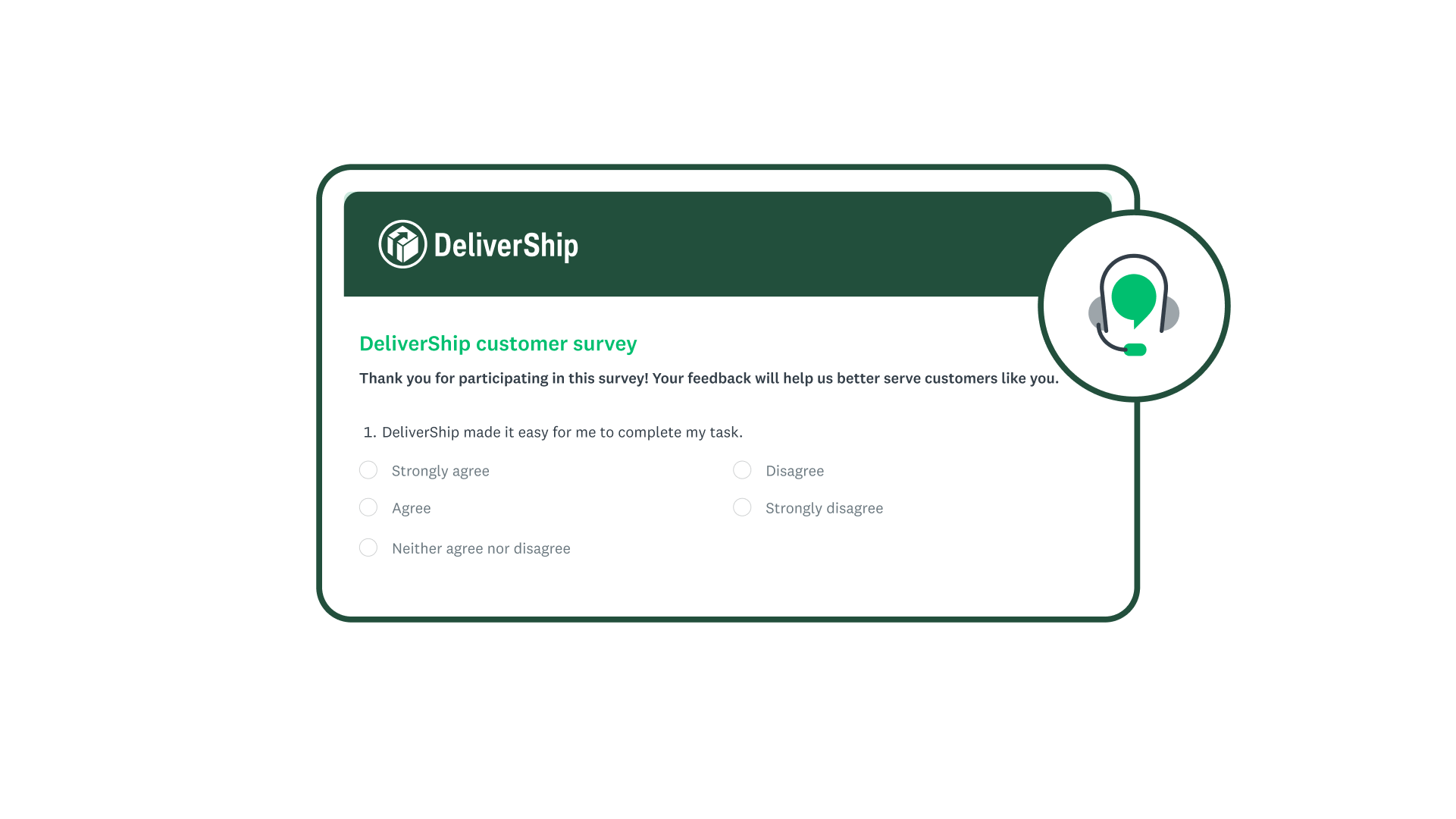
What it measures: Ease of interaction and resolution.
The Customer Effort Score shows how easy it is for customers to complete key actions, such as finding information or resolving an issue. Use the CES survey template to identify friction that affects loyalty.
- Proven loyalty driver: In the 2023 State of CX Research Report, 91% of consumers said they are more likely to recommend a company after a low-effort experience.
- Quick wins: You can identify small changes, such as simplifying checkout copy, with a CES survey to lift conversions.
- Training improvements: CES insights can guide customer service training by identifying where agents or processes slow resolution.
When to use it: After task completion or support interactions to uncover friction and improve ease of use.
Tip: Use NPS to measure long-term loyalty, CSAT for moment-level satisfaction, and CES to track effort. Together they form a balanced VoC scorecard that highlights what to celebrate and what to fix.
6. Analyze the results
Once you begin collecting customer feedback across touchpoints, take time to examine each dataset and compare results by segment, product, and time period. Insight only matters when it’s shared and acted on, so bring together survey, market research, and social channel findings into a single accessible location, such as an internal dashboard or wiki.
Some data, like Net Promoter Score trends, tell a clear story at a glance. But when your surveys include open-ended feedback, use text analysis to surface recurring themes and customer sentiment. To go deeper, apply tools such as crosstabs and custom data filters to uncover patterns within key segments or identify high-impact issues.
The goal is to move from raw data to clear, prioritized insights that inform action. Centralize the most important findings, assign owners, and track outcomes so feedback consistently drives improvement across your Voice of the Customer program.
Common Voice of the Customer challenges and ways to overcome them
Even the best Voice of the Customer programs face roadblocks. Data can get trapped in silos, response rates can fall flat, and enthusiasm across teams can fade. These challenges are fixable, and addressing them turns your VoC program into a more connected, reliable source of truth.
| Challenge | Why it happens | How to fix it |
| Siloed feedback and data | Customer feedback lives across multiple systems—market research, support, social listening, and surveys—which makes it hard to see the full picture. | Bring all feedback into one shared dashboard. Simplify collection and reporting through survey integrations for platforms like Salesforce, HubSpot, Mailchimp, Zendesk, and Zoom. Assign clear owners for data sharing and insights. |
| Low survey response rates | Long, confusing, or poorly timed surveys cause fatigue and lower engagement. | Run a survey best practices audit, and use expert-written customer satisfaction survey questions for clarity. Keep surveys short, use plain language, and send them soon after the interaction. See our guides on increasing CSAT response rates and CSAT survey question best practices for more tips. |
| Limited team engagement | Some teams may not see direct value in customer feedback or struggle to connect it to business outcomes. | Tie VoC outcomes to financial results. Use this guide on how to prove the ROI of customer satisfaction to link improved experiences with retention and revenue. Share key insights regularly and highlight wins that show real business impact. |
Every challenge you solve strengthens your VoC program. Connecting data across tools, improving response quality, and aligning teams around customer outcomes ensures that feedback fuels continuous improvement rather than collecting dust.
5 best practices for building a Voice of the Customer program
A strong VoC program connects data, empathy, and action. Use these Voice of the Customer best practices to strengthen how you listen, analyze, and respond—so feedback becomes a continuous driver of improvement.
1. Design your program around decisions, not data points
Every Voice of the Customer survey question you ask should have a purpose. Before launching a survey, define what decision the data will inform and who will act on it. Clean and validate your responses before analyzing them to ensure your insights are accurate and actionable. Start with this checklist for cleaning your survey data to get dependable results.
2. Balance explicit and implicit feedback
Customer surveys tell you what people say, but behavioral data shows what they do. Compare satisfaction scores with signals like repeat visits, feature adoption, or churn rate to spot hidden friction. If a customer rates your service highly but never returns, dig deeper to uncover the gap between perception and behavior.
3. Measure the employee experience too
Happy employees make for satisfied customers. Partner with HR or people operations to measure engagement using tools like employee engagement surveys or an employee Net Promoter Score (eNPS) survey. You can even track employee satisfaction and engagement alongside your customer NPS to see how internal culture influences external experience.
4. Put your results in context with benchmarks
Tracking improvement over time is essential, but it’s equally important to know how your performance compares to peers. Use industry benchmarks to understand where you stand, set realistic goals, and identify opportunities to differentiate.
5. Keep your VoC program current
Customer expectations evolve fast. Revisit your surveys and metrics regularly to align with the latest customer experience trends and technology shifts. Stay informed on how CX leaders are using AI and new feedback channels to meet changing needs.
By applying these best practices, you’ll build a VoC program that listens intelligently, responds quickly, and adapts continuously, turning customer insights into lasting competitive advantage.
30-60-90 day Voice of the Customer launch plan
You can build a working Voice of the Customer program in just three months. Follow this simple roadmap to move from setup to measurable impact.
First 30 days: Launch and listen
Start small by collecting baseline insights. Send your first customer satisfaction survey or Net Promoter Score survey to key customer segments. Capture quick wins by identifying your top themes and most common feedback.
Checkpoint: Establish your first VoC benchmark for satisfaction, loyalty, and effort.
Days 31–60: Connect and analyze
Integrate your survey data with the tools your teams already use, such as CRM or help desk systems. Use text analysis and crosstabs to uncover patterns in open-ended feedback. Share a short summary of findings across teams and assign owners for next actions.
Checkpoint: Present your first cross-team insights and prioritized actions.
Days 61–90: Act and demonstrate impact
Turn insight into action. Fix one issue that customers consistently mention, improve a friction point, and share visible progress. Use your second survey wave to show movement in your key metrics.
Checkpoint: Report back on improvements, highlight wins, and set new targets for the next quarter.
In just 90 days, you’ll have a functioning feedback loop—one that listens, learns, and proves that customer voice drives real results.
Build your Voice of the Customer program and start listening today
Turn customer feedback into action with SurveyMonkey. Build and launch your Voice of the Customer program quickly using expert-written templates that help you collect, analyze, and act on insights—all in one connected platform.
Get started free with a Voice of the Customer survey template to begin gathering meaningful feedback right away. If your organization needs advanced integrations, governance, or analytics, learn how SurveyMonkey can power your VoC program.
NPS, Net Promoter & Net Promoter Score are registered trademarks of Satmetrix Systems, Inc., Bain & Company and Fred Reichheld.
Discover more resources

Solutions for your role
SurveyMonkey can help you do your job better. Discover how to make a bigger impact with winning strategies, products, experiences, and more.

Why are surveys important in research?
Surveys are important in research because they offer a flexible and dependable method of gathering crucial data. Learn more today.

NPS surveys: Best practices for high response rates
Learn NPS survey best practices to drive high response rates by improving survey processes.

23 ways to increase CSAT response rates
It's hard to improve your customer satisfaction scores without respondents. Get SurveyMonkey's best actionable tips to improve your response rate.