Post event survey questions to ask: Examples, tips and best practices
Host more successful events when you use surveys to collect feedback from your attendees.
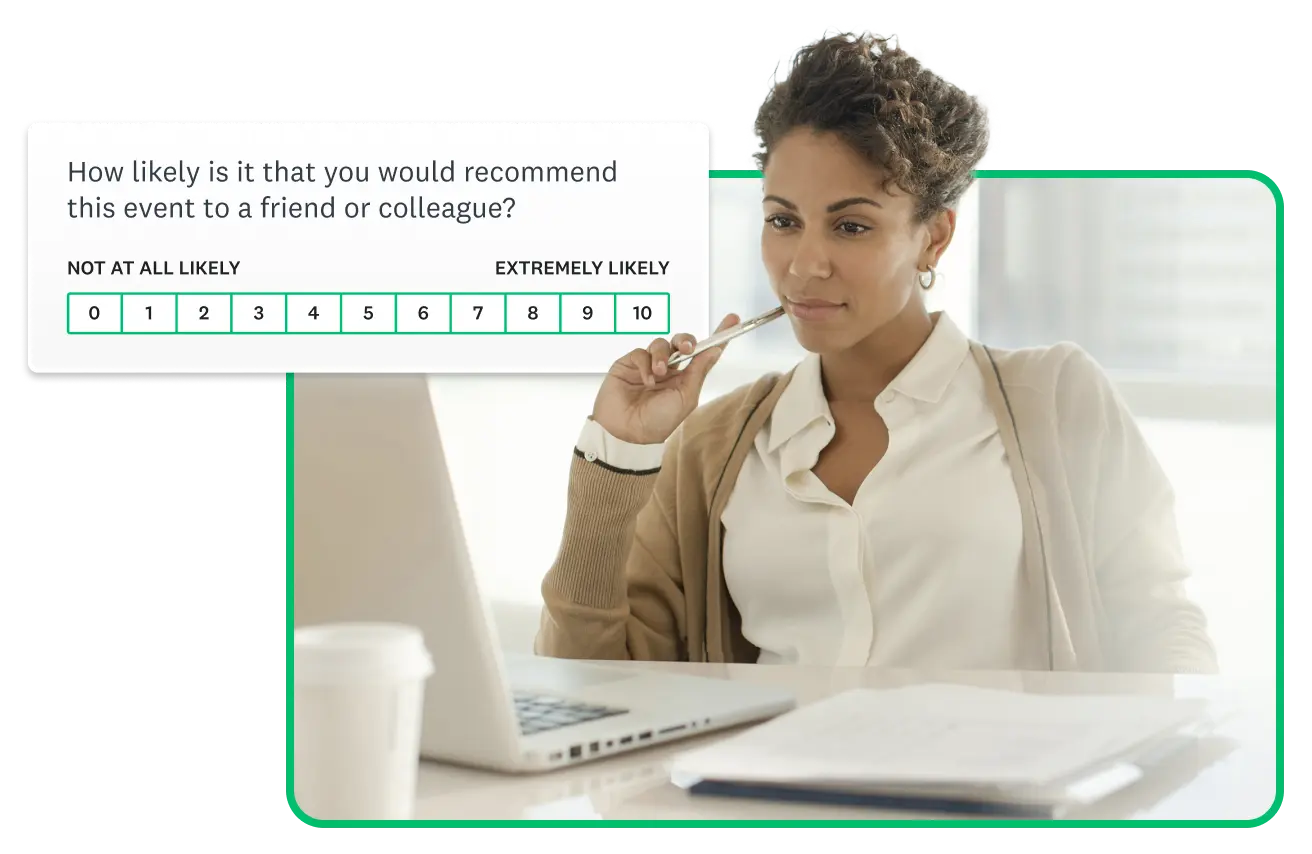
After an event ends, there’s one more important step: learning what worked. The right post-event survey questions turn quick reactions into clear feedback you can use to plan the next event more confidently.
This guide gives you copy-ready event survey questions by audience, guidance on when to send your post-event survey, and templates you can launch quickly, plus practical examples and tips you can apply right away. You can use it to build an event feedback survey that’s short, focused, and easy for people to complete.
Why send post-event surveys?
A post-event survey is a set of short questions sent soon after an event to capture impressions while the experience is still fresh. It turns quick reactions into clear, comparable feedback you can use to confirm what worked, surface friction, and decide what to change next time.
These surveys create a feedback loop between planning and real attendees' needs. Instead of guessing, teams can rely on consistent post-event survey questions or a full event feedback survey to track how each event performs over time.
Collaborate on surveys as a team
Get features that support creating, sending, and analyzing surveys as a team.
Build trust
Asking attendees for their opinions sends a clear message that you care about their experience and will use their feedback to improve future events. Over time, that transparency builds trust and makes people more willing to respond.
Eliminate the guesswork
Instead of relying on a hunch that a speaker didn’t quite hit the mark, you’ll have participant responses to gauge the performance of individual sessions and the overall event. That makes it easier to spot patterns across content, format, or logistics.
Use the Entertainment Event Feedback Survey Template to identify questions that can improve presentations and performances at your next event.
Estimate event growth
You can use a variety of different surveys after your events. One in particular, a Net Promoter Score® (NPS) survey can help you gauge future growth of your events by asking attendees if they would recommend it to a friend. That will give you an indication of whether your next event could have a larger turnout from word-of-mouth marketing.
Improve future events
Constructive survey feedback gives you a clearer way to plan future events for the best attendee experience. It can also help you refine marketing to improve attendance. Responses can point to changes in the registration process, the quality of the food, the friendliness of the event staff, and even the production costs. The Event Planning Survey Template is useful for planning your next event.
Get event feedback fast with our sample survey template
SurveyMonkey offers ready-made event survey templates that focus on core post-event survey questions, keep surveys short, and use a mix of question types so most people can finish in just a few minutes.
Like what you see?
You can customize your survey with the questions above or send it as-is in minutes. Learn more about our plans and pricing, or get started for free.
40 post-event survey questions
Thoughtful post-event survey questions turn a handful of comments into clear patterns you can use to improve future events. The lists below give you copy-ready question sets by audience so you can build an event feedback survey that is short, focused, and easy to answer.
Each set mixes rating, multiple-choice, and open-ended questions. You can use 5–10 questions per audience, depending on whether you are running a quick post-event questionnaire, a more detailed event feedback survey, or a post-conference survey.
Public events
Public events, such as fundraisers, store openings, and trade shows, help you reach people outside your immediate circle. These questions focus on overall satisfaction, clarity, and accessibility.
- How satisfied were you with the event?
- What did you like most about the event?
- What did you like least about the event?
- How likely are you to attend one of our events in the future?
- How likely are you to recommend our events to a friend?
You can adapt this set for a short post-event survey or combine it with more detailed event feedback questions for deeper insights.
Conferences
Professionals come together at conferences to share knowledge, set industry standards, and build their networks. These conference survey questions focus on overall experience, objectives, structure, and future topics.
- How satisfied were you with the conference?
- In your opinion, did the conference meet its objectives?
- How well was the conference structured?
- Was there enough time for discussion?
- Which topics would you like to see covered at future conferences?
This set of post-conference survey questions is the critical feedback loop needed to precisely evaluate your recent event's success and pinpoint areas for improvement to ensure your next conference achieves greater impact and value for attendees.
Training courses
A successful professional training course equips participants with new, useful skills that expand their opportunities. These questions help you see whether the course delivered on that promise.
- How satisfied were you with the course?
- How useful was the information presented in this course?
- Did the course improve your skills?
- Did you have an opportunity to ask questions during the course?
- What would have made the course better?
You can reuse similar wording for post-meeting survey questions after longer working sessions, planning retreats, or other collaborative internal gatherings, ensuring consistency in measuring outcomes and engagement.
Speakers and presenters
Speaker feedback helps you understand how well individual sessions were received and where to improve. These after-event survey questions focus on clarity, relevance, and engagement.
- How clear and easy to follow was this speaker’s presentation?
- How relevant was the content to your interests or role?
- How engaging was the speaker’s delivery (voice, pacing, visuals)?
- Was the amount of time for Q&A appropriate?
- How likely are you to recommend this speaker or session to a colleague?
These post-event survey questions for attendees can be asked right after each session or bundled into your main post-event survey.

Exhibitors and sponsors
Exhibitors and sponsors see the event from a business and partnership perspective. Use these event feedback survey questions to understand value and logistics.
- How satisfied were you with attendee traffic to your booth or sponsored activity?
- How would you rate the overall quality of the leads or contacts you collected?
- How satisfied were you with communication from the event team before and during the event?
- Did you have any challenges with booth location, setup, or logistics?
- How likely are you to exhibit at or sponsor this event again?
Send these event feedback questions only to exhibitors and sponsors so you can track partnership satisfaction separately from attendee feedback.
Event staff and volunteers
Staff and volunteers experience the operational side of the event. Their feedback shows where planning and communication can improve.
- How clear were your responsibilities before the event began?
- How prepared did you feel for your shift or role?
- Did you have the tools, information, and support you needed during the event?
- How clear and timely was communication about schedules or changes?
- What challenges did you encounter during your shift, and what would make it easier next time?
You can use these questions as a short post-event survey for staff or volunteers, or as part of a broader operations event feedback form.
Additional post-event survey questions
These flexible prompts work across event types and formats. Use them to round out your post-event survey questions examples with a few more open-ended insights:
- What were your favorite features of the event?
- What, if anything, did you dislike about this event?
- How satisfied were you with the networking opportunities provided?
- What was your biggest takeaway from this event?
- Would you attend another event like this in the future?
- What is your job title?
- How likely are you to recommend this event to a friend or colleague?
- What topics would you like to see covered in future events?
- Was the signup process for our event easy?
- Did the event meet your expectations?
Mixing a few questions from these lists lets you tailor a post-event survey or post-event questionnaire to your audience without overwhelming respondents.
While it’s a good idea to ask participants for feedback before, during, and after an event, sending surveys after events often provides the best insights. Use the questions above as a jumping-off point when writing your own post-event survey questions.
Go a step further with pre-event questions
Successful event planners use pre-event survey questions to get to know participants. Pre-event surveys yield beneficial information that will make your event more comfortable, accessible, and successful for you and your attendees. Pre-event survey questions also provide key information for use in planning future events.
Shortly before an event, use a pre-event survey to gather information about your marketing methods, preferred audience, and special needs of your participants. Send the survey in a confirmation email or present it as a popup when registration is complete.
- How did you hear about this event?
Find out which of your marketing efforts are most effective. Use the information to target your audience for greater reach for your next event.
- What sessions are you most interested in?
Find out what the excitement level is around certain speakers or agenda items. This will help later when you are looking for event sponsors and growing your audience.
- What is your favorite social media platform?
Know where your audience is most likely to engage so you can direct your efforts in the right channels.
- Have you attended this event before?
It’s great to know if your event generates loyalty in attendees. This helps prove repeat engagement, a metric that potential sponsors will be very interested in.
- Do you have any special needs or requirements that we should be aware of?
Ensure your event is accessible to anyone by providing multiple choices including mobility, hearing, sight, and other assistance. Add a comment box so attendees can add options you may have overlooked.
- Do you have any dietary restrictions we should be aware of?
Whether it’s a food allergy, sensitivity, or cultural food restriction, if a participant can’t enjoy the refreshments, it puts a damper on their day.
- Were you able to easily find all of the information you need about our event?
Ensure that there are no confusing parts of the registration process or locating information regarding speakers, agendas, and more.
10 types of post-event survey questions
There are several types of survey questions, and you’ll notice that some of them overlap, for example, a Likert scale question is a rating question and a closed-ended question.
The properties of each question type determine its usefulness for your survey. Consider what type of feedback you’re looking for to help you choose the best questions for your specific needs.
Related reading: Survey question types—examples and tips from experts
1. Likert scale questions
A Likert scale question is a closed-ended question with a series of answers that rank satisfaction from one extreme attitude to another. It’s a specific type of rating scale that focuses on an odd-numbered range of equally distributed answers with a neutral choice at the center. While a Likert scale is a type of rating scale, the opposite is not necessarily true. Likert scale questions exclusively focus on answers on a defined spectrum.
You’ve probably taken surveys like this to rate your satisfaction with a service or experience you’ve attended.
Likert scale question examples:
- How satisfied are you with the variety of topics presented at the conference?
- Very satisfied
- Somewhat satisfied
- Neither satisfied nor dissatisfied
- Somewhat dissatisfied
- Very dissatisfied
- I’m happy with the amount of information presented in today’s sessions.
- Strongly agree
- Agree
- Neither agree nor disagree
- Disagree
- Strongly disagree
2. Open-ended questions
Open-ended questions explore a survey respondent’s insights and opinions. These questions ask for the respondent to provide their own individual answers in short-answer format. The answers don’t provide statistical information, but the qualitative data is invaluable.
Open-ended question examples:
- What was your favorite part of the conference?
- Tells us about your least favorite part of the offsite?
- Do you have any suggestions for next year’s event?
3. Closed-ended questions
Closed-ended questions include multiple-choice, drop-down choices, checkboxes, and ranking questions. Unique responses aren’t allowed—the respondent must choose from a list of predetermined answers.
Closed-ended question examples:
Are you planning to return to next year’s event?
- Yes
- No
- I don’t know
The event provided me with valuable information.
True | False
Considering your attendance at the conference, which of the following parts did you feel was most valuable? Please rank your preference from highest to lowest.
4. Rating scales
Rating scale questions are closed-ended in that they don’t allow the respondent to enter their individual answers. Responses are presented in either a numbered (such as 1-10) or worded as a scale (Very satisfied-very unsatisfied). Rating scale questions allow you to measure the opinions of event attendees in a quantitative manner. Unlike Likert scale questions, rating scale questions can use any type of rating choice, such as stars or numeric responses.
Rating scale question examples:
On a scale of 0-10, how likely are you to recommend this conference to a friend or colleague?
How would you rate your overall experience at the event?
- ★ Terrible
- ★★ Poor
- ★★★ Neutral
- ★★★★ Good
- ★★★★★ Excellent
5. Multiple-choice questions
Multiple-choice questions are useful because they offer participants options from a list of answers that you’ve defined.
Multiple choice question example:
Which part of the event was most interesting to you?
- Keynote speaker
- Session A
- Session B
- One-on-one sessions
6. Matrix questions
Matrix questions are closed-ended questions that ask respondents to evaluate items using the same set of choices arranged in columns.
Matrix question example:
Please indicate how strongly you agree with the following statements:
| Strongly disagree | Disagree | Neither agree nor disagree | Agree | Strongly agree | |
| I like to know trends before others | |||||
| Colleagues come to me for advice | |||||
| I have no interest in trending topics |
Related reading: 4 tips for writing matrix questions
7. Demographic questions
A quick, painless way to gather information about your audience and can help inform your buyer persona. This will help you formulate your marketing strategy for future events. This demographic survey will show you the types of questions that yield demographic information from your survey takers.
Demographic question example:
What is the highest level of education you have completed?
- Some high school
- High school
- Some college
- Associate’s degree
- Bachelor’s degree
- Graduate degree
- N/A
8. File upload questions
If you’d like supporting documentation, photographs, or other information beyond a simple survey, a file upload question is the solution. A file upload option allows survey takers to easily upload whatever supporting documents or images you require. Check out our best practices for using file uploads in your surveys.
File upload question example:
Please upload a photo of yourself for your event name tag.
9. Slider questions
A slider question offers a sliding scale to indicate the answers to questions. These are useful when you want participants to answer specifically, but also want to easily gather the data. For example, if you want to find out how often someone engages in a behavior, rather than offer them closed-ended choices that may not be fully accurate or open-ended choices that make data more difficult to collect and quantify, a sliding scale may work perfectly.
Slider question example:
How many times did you visit our website before registering for this event?
10. Benchmark questions
Give context to your survey results with benchmark questions. The answers to these questions can be compared to others who used the same questions you did. Learn more about SurveyMonkey Benchmarks.
Not looking to start from scratch? Browse through our survey templates to find the best template for collecting event feedback.
How to conduct a post-event survey

A post-event survey is most effective when it’s planned and delivered with intention. Clear steps for preparing, sending, and following up can lift response rates and improve the quality of event feedback you collect. Use this five-step workflow to keep your post-event survey process consistent and easy to repeat.
1. Prepare your survey before the event
Collect contact details during registration so you have a clean list when it’s time to send your survey. Ask for email, phone number (if needed), and preferred contact method.
Draft your post-event survey in advance and save it in SurveyMonkey, or start with the Post-Event Feedback Survey Template and adjust the wording for your event. You can set up an email collector in advance, so survey invitations go out automatically on the day and time you choose.
If you are juggling many pre-event tasks, the Event Planning Checklist can keep registration, communications, and survey prep in one place.
2. Send your survey within one business day
Aim to send your main post-event survey within one business day of the event. That’s when details are still top of mind, and people are more likely to respond.
You can:
- Use an email collector to send a branded email invitation
- Share the survey link in your event app, chat, or follow-up message
- Load the survey on tablets or laptops at the venue for quick, on-site responses
Give people a clear reason to respond by noting that feedback from past events helped shape this one and will guide future improvements. You can do this with a short line in your invitation email or closing remarks.
3. Keep it short
Short post surveys respect people’s time and usually have higher completion rates. A good rule of thumb is to keep your post-event survey to 10 questions or fewer, which most people can finish in about three minutes.
4. Send up to two reminders within two weeks
Give attendees a few days to respond to your first invite, then send one or two reminders over the next two weeks. Limit it to three total messages so you don’t overwhelm people. After about a month, stop sending reminders because people will remember fewer details and the responses will be less reliable.
The automatic reminder features let you schedule follow-up emails only to people who have not responded yet, so you don’t have to track that list by hand.
5. Use the thank you page to close the loop
When someone completes your survey, the Thank You page is an opportunity to express appreciation and keep them engaged with the event. Customize it with:
- A short thank-you message that mentions how you’ll use their feedback
- Links to keynote videos, slide decks, or photo recaps
- A link to learn about future events or sign up for updates
The custom Thank You page options make it easy to add links to videos or slides and guide attendees to their next step. This simple follow-up deepens engagement and turns your post-event survey into part of the overall event experience, not just an extra task.
When to send post-event surveys
Send your post-event survey questions to attendees while the event is fresh in their minds. Rather than collecting data on paper surveys, an online survey will increase your response rate. You can provide a link right at the end of your sessions or send the survey after the event when people have more time to devote to the survey. You can also put a survey QR code or link into the event presentations making it incredibly easy to provide feedback.
You’ll also receive more responses if you keep your survey short at 10 or less questions so people can provide meaningful answers.
Frequently asked questions
- What kinds of questions are asked on post-event surveys?
- When should you send a post-event survey?
- How can the results of post-event surveys be used?
- How many questions are ideal for a post-event survey?
- Should I make my post-event survey anonymous?
- What’s a good response rate for a post-event survey?
- What is NPS, and should I include it in my event survey?
Prepare your post-event survey questions now
Now that you know the types of questions you can ask, how the data is useful to you, and have a bank of examples to refer to, what are you waiting for? SurveyMonkey has everything you need to write your pre and post-event surveys quickly and efficiently.
There’s enormous value in sending surveys to participants after an event. We’ve given you an idea of the types of questions you can ask, information on how to use the data, instructions for how to conduct a post-event survey, and a bank of sample questions. Don’t you think it’s time to get started?
SurveyMonkey has everything you need to create your event surveys. You can customize your survey with the questions above or use a template and send it as-is in minutes. Learn more about our plans and pricing, or get started for free today.
Discover more resources

Solutions for your role
SurveyMonkey can help you do your job better. Discover how to make a bigger impact with winning strategies, products, experiences, and more.

Product feedback surveys
Our product feedback surveys give you the insider knowledge you need to plan new products, grow your business and succeed in today's competitive marketplace. Here are a few ideas on how you can send product surveys, get feedback and develop successful marketing strategies. Get started now.

Why are surveys important in research?
Surveys are important in research because they offer a flexible and dependable method of gathering crucial data. Learn more today.

Ad testing: Why it matters and how to successfully perform it
Learn the best practices for performing an ad test—from brainstorming your questions to analyzing your results—so you can confidently land on the best option.
Power your business with SurveyMonkey
NPS, Net Promoter & Net Promoter Score are registered trademarks of Satmetrix Systems, Inc., Bain & Company and Fred Reichheld.