50 customer satisfaction survey questions to strengthen CSAT
Strengthen CSAT with surveys. Use our expert-written customer satisfaction survey questions and free templates to better understand your customers.

Half of CX pros believe customer satisfaction has improved over the last six months, but only 18% of consumers agree. In fact, 53% of people say it’s actually gotten worse. That disconnect highlights the importance of listening to your customers (and asking the right questions).
There’s an art to writing an effective customer satisfaction survey. To help, we’ve compiled 50 examples of customer satisfaction survey questions, along with tips to avoid common mistakes and get more accurate feedback.
What are customer satisfaction surveys?
Customer satisfaction surveys enable you to evaluate customer sentiment at both a micro and macro level. They capture how satisfied people are with your product or service, how well your customer service experience meets expectations, and how customers feel about your organization overall.
The Customer Satisfaction Score (CSAT) survey is the most widely used method for measuring satisfaction. It asks customers to rate their experience on a standardized scale, giving you a clear, comparable metric you can track, benchmark, and pair with other signals like Net Promoter Score (NPS®) and Customer Effort Score (CES).
Together, these metrics help teams identify what’s working, where friction exists, and which improvements will have the biggest impact on the customer experience.
Why are customer satisfaction surveys important?
Customer satisfaction surveys are important because they measure how well a product, service, or experience meets customer expectations and reveal where improvements will have the greatest impact. They surface what customers value, highlight sources of friction, and create a clear baseline for tracking satisfaction over time.
Organizations use customer satisfaction survey data to:
- Identify trends and shifts. Regular CSAT tracking makes it easier to spot emerging issues or improvements across the customer journey.
- Prioritize what matters most. Feedback helps teams understand which touchpoints, such as onboarding, support, delivery, or checkout, need attention first.
- Evaluate performance with metrics. CSAT, NPS, and CES together provide a fuller picture of satisfaction, loyalty, and ease of experience.
- Validate decisions and changes. Surveys confirm whether new features, service updates, or pricing adjustments meet expectations.
- Strengthen relationships through transparency. Asking for feedback and showing that it informs decisions helps build trust with customers.
In short, customer satisfaction surveys turn subjective experiences into measurable insights, helping teams understand how customers feel today and where to focus for tomorrow.
50 customer satisfaction survey questions
General customer satisfaction survey questions are beneficial. However, tailored industry-specific questions, like financial services and call centers, will get the most accurate data. Here are 50 general and industry-specific customer satisfaction survey questions to get started.
General satisfaction questions
Use these customer satisfaction survey questions when you want a broad read on customer sentiment. They work well for post-purchase check-ins, periodic experience pulses, or anytime you need a trendable satisfaction signal. Keep your scale consistent and add a simple follow-up to understand what shaped each rating.
- Please rate your overall satisfaction with [company].
- Is there anything else you'd like to share about your experience with [company/event/service/purchase]?
- What is one thing we could do to improve your experience with [company/service]?
- What would you suggest to help us improve our [product/service]?
- What is one thing we could do to improve your experience with [company/service]?
- On a scale of 1 to 10, how satisfied are you with [product/service]?
- Would you recommend [product/service] to friends and family?
- Is there anything else you'd like to share or suggest to help us improve our [product/service]?
Industry-specific satisfaction questions
Customer satisfaction standards vary by industry. These questions are designed to highlight the moments that matter most in each unique environment, allowing you to precisely measure experience across sectors where expectations, regulations, and workflows differ, providing a relevant and actionable score for your market.
Financial services
In financial settings, satisfaction is defined by clarity, trust, and ease of completing tasks. These questions help you evaluate critical touchpoints—like onboarding, product transparency, and issue resolution—where expectations are high and friction strongly affects loyalty.
- How satisfied are you with our banking application process?
- How satisfied are you with the transparency of our financial [products/services]?
- Did our services meet your financial needs and goals?
Healthcare
Healthcare satisfaction surveys focus on communication, cleanliness, access, and quality of care. These questions help you understand how effectively patients move through appointments, receive information, and interact with medical staff—factors that strongly influence patient confidence and follow-through.
- How satisfied were you with the level of care you received from our medical staff?
- How would you rate the cleanliness of our clinic?
- How satisfied are you with the appointment scheduling process?
- Please rate your level of satisfaction with the communication you received from our medical staff.
Food and beverage
Restaurant and hospitality environments depend on service quality, ambiance, and consistency. These questions assess how well each part of the visit met expectations, from the menu and atmosphere to the attentiveness of staff and the overall dining experience.
- How would you rate your satisfaction with your recent visit to our restaurant?
- Did the ambiance of our restaurant meet your expectations?
- How would you rate the quality of the food and beverages you received?
- Were you satisfied with the attentiveness of the waitstaff?
- Were there any specific dishes or menu items that stood out to you? Please share.
Ecommerce
Online shoppers expect speed, clarity, and easy self-service. These questions help identify friction in browsing, checkout, delivery, and returns—moments that have an outsized impact on repeat purchases and cart abandonment.
- Were you satisfied with the ease of navigating our website and finding the products you wanted?
- How satisfied are you with the checkout and payment process?
- Were the delivery and packaging of your order up to your expectations?
- How satisfied are you with the speed and reliability of our [delivery/shipping]?
Education
Educational experiences hinge on communication, accessibility, and instructional quality. These questions measure how students or participants perceive course content, support resources, platform usability, and their overall learning environment.
- Were you satisfied with the quality of instruction and course content?
- How would you rate the availability and accessibility of resources?
Hospitality
Guest experience is shaped by first impressions, cleanliness, amenities, and responsiveness. Use these questions to evaluate how well the service meets expectations and where service, facilities, or communication can be improved.
- How satisfied were you with your recent stay at our hotel?
- How satisfied were you with the cleanliness of your room?
- Were the amenities up to your expectations?
- How satisfied are you with the check-in and check-out experience?
- How likely are you to recommend our hotel to your friends and family?
Event satisfaction questions
Events succeed when logistics, content, and support all work together. These customer satisfaction questions capture how attendees experienced communication, staff helpfulness, programming, and ease of accessing event information, helping you refine future sessions and engagement strategies.
- How would you rate your overall satisfaction with the trade show you recently attended?
- How satisfied are you with the communication you received from the event organizers?
- Were the staff and employees helpful and friendly during the event?
- How easy or difficult was accessing information and resources related to [event name]?
- Please share a memorable moment or experience from [event].
- How likely are you to attend [event] in the future?
Customer support satisfaction questions
Support interactions are high-stakes moments that influence trust and retention. These customer satisfaction questions measure communication quality, response time, agent helpfulness, and issue resolution—core drivers of satisfaction after a service touchpoint.
- How would you rate your satisfaction with the communication you received from [department]?
- How satisfied were you with the response time of our customer support team?
- How would you rate the helpfulness of our customer service representatives?
- Rate your level of satisfaction with your recent customer service experience.
- Was your issue resolved to your satisfaction?
Website and mobile app satisfaction questions
Digital experiences rely on clarity, speed, and navigation. These questions help you assess how easily users find information, move through tasks, and complete actions—key indicators of an effective website or app experience.
- How would you rate your satisfaction with our mobile app?
- How easily were you able to navigate through our website?
- Were you able to find the information you were looking for?
- How satisfied are you with the checkout process on our [website/mobile app]?
- Did you encounter difficulties using our [website/mobile app?] Please explain.
Pricing and value satisfaction questions
Perception of value plays a major role in overall satisfaction. These questions help you understand how customers view your pricing, whether expectations match what they received, and where clarity or fairness can be improved.
- How satisfied are you with the pricing of our [product/service]?
- Do you believe [product/service] offers good value for the price?
- How satisfied are you with the [product/service] you received in exchange for the price you paid?
What is Customer Satisfaction Score (CSAT)?
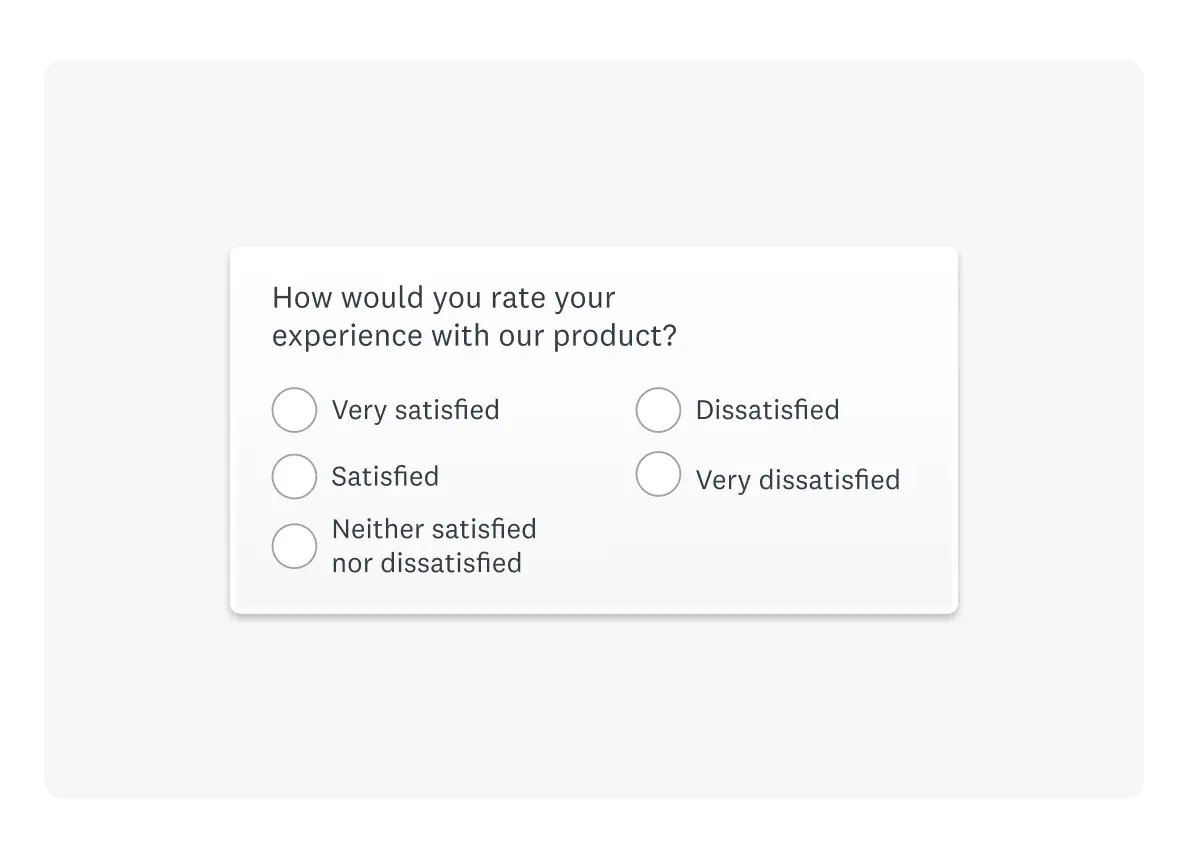
The Customer Satisfaction Score metric is a measurement that determines how happy customers are with an organization, its products or services, and its capabilities. CSAT asks: “How would you rate your experience with our (fill in the blank)?” where the responses range from “Very satisfied” to “Very dissatisfied.”
How to calculate CSAT

To calculate your CSAT score, divide the number of satisfied customers by all your respondents and multiply the result by 100. You’ll end up with a percentage; the higher it is, the more satisfied your customers are. Check out our ultimate guide to Customer Satisfaction Score to learn CSAT best practices, industry benchmarks, and more.
Related reading: Calculate customer satisfaction with our CSAT calculator
How to build good customer satisfaction surveys

Now that you know about the customer satisfaction survey questions you can ask, let’s talk about common mistakes when building the survey—and what you can do to correct them!
1. Using restrictive answer options
When your answers don’t include the response your participant wants, you’ve created a frustrated experience for your respondents. They now face the decision to answer inaccurately, skip the question, or abandon the questionnaire altogether. Not very productive. To let your question be inclusive of all opinions, offer an “I don’t know” answer choice or an “other” textbox or comment field.
2. Asking two-part questions with only one response option
This question-writing mistake is as simple as it sounds. Take the following as an example:
- “Did you enjoy our service and new menu? Yes or no?”
What if your service was impeccable, but the food was lacking? If there’s no way for the customer to answer this question accurately, you’ll get skipped questions, or, perhaps even worse, inaccurate responses. Make sure you’re asking for one distinct answer per question.
Returning to our example, you can break up the prompt:
- Survey question 1: “Did you enjoy our service?”
- Survey question 2: “Did you enjoy our new menu?”
3. Requiring a response to every question
Yes, it would be great if every single question in your customer satisfaction feedback survey was answered thoughtfully and completely. That just doesn’t happen in the real world; people are busy and get distracted. Sometimes a question is missed due to oversight, sometimes the respondent doesn’t want to provide the information, and sometimes they’re just confused by the question.
If you require an answer to every single question—even the most rudimentary ones—you’ll find that many respondents will leave your survey. So keep the required questions to a minimum and let them skip what they want.
4. Asking too many questions
Don’t interrogate your kind participants with page after page of highly detailed questions about every facet of your business. Keep your client feedback survey as succinct as possible, and you’ll be more likely to get meaningful data. Remember, you can always do follow-up surveys, and you’ll learn more with each poll you do.
5. Forgetting the goal of the survey
It’s easy to ask a lot of questions in order to get the most information you can. But each survey should have a specific goal in mind, one that every question should help reach. Stay focused on your goal, and you’ll get valuable information.
6. Attaching opinions to the questions
It’s hard to be objective when you think your customer service is outstanding. Take a step back from what you think you know and let your shoppers do the talking. Avoid embellishing your questions with superlatives. Take the prompt:
- “How would you describe our friendly customer service representatives?”
This is a leading question as it describes the reps as “friendly.” As a result, it isn’t likely to provide accurate results. Instead, ask a focused question about an aspect of your customer service, such as:
- “How responsive or unresponsive were our customer service representatives?”
7. Getting stuck in the hypothetical
It’s hard for most people to accurately determine what they may or may not do in a hypothetical situation. Don’t fabricate customer service “what if” situations that may not have happened to the respondent. Instead, focus on uncovering real customer service issues.
For instance, avoid question prompts like:
- “If our customer service representatives were extremely responsive to your needs, would you give our business a higher rating?”
And instead, ask:
- “How satisfied or dissatisfied are you with the performance of our customer service representatives?
Pro tip: Use a Likert Scale rating question to ask customers to rate their experiences.
8. Writing complicated questions
If your participants have to read questions several times in order to understand them, or if they’re repeatedly asked to write essay-like responses, you’ll end up with a lot of abandoned questionnaires. Write questions that can be easily scanned and that don’t require a lot of time to answer.
To make this point more concrete, let’s compare two question prompts that are ultimately asking the same thing. Here’s one that’s direct and simple:
- “How responsive (or unresponsive) is our company in answering your questions?”
Now see what happens when you make it ultra-specific and long:
- “If you have used our website, phone system, or email help system in the past, did our customer service representative get back to you in a timely manner?”
9. Including unnecessary questions
You’re probably eager to collect as much information as you can from each survey, but avoid the temptation. Customer service surveys that veer off course and ask seemingly unrelated questions can distract or confuse the respondent, and in some cases, may even evoke suspicion.
The examples are seemingly endless. And can be anything from…
- “What do you like to do during your free time?”
to…
- “Are you happy?”
10. Using yes or no answer options
You could ask the following question with “yes” or “no” answer options:
- “Is our company professional?”
But there’s a subtle spectrum of positive and negative responses. To get even richer data, try asking a “how” question with available responses, like, “extremely professional,” “somewhat professional,” and “not at all professional.” In short, modify the question prompt to: “How professional is our company?”
Free online customer satisfaction survey templates
At SurveyMonkey, we’ve developed a collection of methodologist-certified customer satisfaction survey templates to get you started quickly and easily. Of course, you’re always welcome to customize the questions to make your survey as specific as you’d like.
Customer satisfaction template
Use this customer satisfaction survey template to measure consumer satisfaction with your company, product, and services. Use skip logic to allow your customers to answer questions about products or services they’ve used and gain insights for improvement.
Customer satisfaction with customer service survey template
See how your frontline customer service and support agents are doing. Measure customer service hold times, problem resolution, product/service knowledge, and representative attitude.
Business-to-Business survey template
This customer satisfaction survey template is designed for when your clients aren’t just clients, they’re businesses too. Identify how satisfied your customers are with your timeliness, professionalism, and service.
NPS, Net Promoter & Net Promoter Score are registered trademarks of Satmetrix Systems, Inc., Bain & Company and Fred Reichheld.
Discover more resources

Solutions for your role
SurveyMonkey can help you do your job better. Discover how to make a bigger impact with winning strategies, products, experiences, and more.

Why are surveys important in research?
Surveys are important in research because they offer a flexible and dependable method of gathering crucial data. Learn more today.

NPS surveys: Best practices for high response rates
Learn NPS survey best practices to drive high response rates by improving survey processes.

23 ways to increase CSAT response rates
It's hard to improve your customer satisfaction scores without respondents. Get SurveyMonkey's best actionable tips to improve your response rate.